Powered By Blogger

Sunday, 6 July 2014

What I love about Russia and other stuff


There is still nothing like a nice cup of tea, with milk.  And there is absolutely nothing wrong with the odd shot of vodka too to get you in the mood.


I do apologise for the stereotypes depicted above.  Just kidding...No I don't!

Nine months in

I can't believe that I have already spent just over nine months in Russia.  It really has flown by.  I must be having too much fun or working hard.  Or both.  I have decided that I want to stay for at least another year in Saint Petersburg.  One year here is just not nearly enough.  When I first arrived I experienced the initial euphoria of being in a new country, which gave way to certain feelings of frustration after the novelty of Russian life had worn off.  Then, over the last few months I have grown an affection for my host country and have a renewed interest in its language and culture.  As I have mentioned before in previous posts, living in Russia has its own particular annoyances, but overall I have been overwhelmed by the friendliness and generosity of the Russian people I have met thus far.  I would also like to take the opportunity to pay a wee tribute to my ex-patriot and Russian colleagues and friends who have been outstanding in making me feel welcome and a valued member of the teaching staff.  And also my students who have made teaching a pleasurable and rewarding experience.  I would like to say a huge thank you to my last class; an upper-intermediate class who excelled with very good final grades indeed -  Margarita, Maria, Alexey and Tanya - well done! 

Alexey and Tanya enjoying the delights of the English Wagonwheel

So, since I have been away from the UK, have I missed anything?  And, what's keeping me in Russia?

What I miss about the UK

  • Friends and family - that almost goes without saying.  And that includes my ginger furry friend, Magnus the cat.  
  • Good ale - especially certain ones like Banana Bread Beer.  
Sexy beer with a hint of banana
  • Cheaper, good-quality food - say what you will about food in Britain, I still like the fact that fresh food is abundant and at a reasonable price.  I could really do with some real British or Danish bacon right now.  
    A sexy bacon sandwich...mmm...baaaacon. 
  • The English countryside - when you're in your home country you tend to take it for granted.  There is a lot to be said for the beauty of the English countryside.
  • Christmas - I'm no massive fan of Christmas, especially the tacky elements, but as Russians don't really celebrate it, I did kind of miss it last year.  Mince pies, Christmas cake, stuffing - you get the picture.

What I don't miss about the UK

  • My last job - Anyone who knows me knows exactly why.  The only thing I miss about teaching at the prison are my former colleagues.  Okay, not all of them, but a fair few.  
  • Crap, expensive transport - almost self-explanatory.  Over-priced buses and trains that offer a poor service at an exorbitant price.  
Waiting for a crap bus?  Then, get down and boogie!
   
  • Chavs - the very people who make travelling on the 'peasant-wagon' even worse.  
 

  • Crime - I know that crime exists in every corner of the globe, but I think it is a huge problem in the large cities.  
  • High taxes - If the chavs/criminal classes don't rob you, HM Revenue and Customs will.  And then when they are finished, your local council will take another slice out of your salary.  
  • Political correctness - It's the disease that has spread over the last few decades consuming freedom of speech (and thought) as it pervades our daily lives.  So, you're not allowed to fly the English flag in England for fear of causing offence?  Well, cover me in flour and bake me for fifteen mintutes!  That is just fookin' bonkers!  I could go on about this for more than fifteen minutes...
  • Negativity/moaning - Yes, I know, I'm guilty of this too.  It's such an English trait and one that just grinds you down when you have to listen to others gripe.  Even worse, when it's about nothing important.  I gripe about the wider issues (see above) 'n' shit.

What I love about Russia


  • Friendly, plain-speaking people - with a no bullshit, and a no political correctness.  It's refreshing to say the least.  And yes, Russian people do appear to be cold at first, but beneath those icy exteriors, are layers of warmth and smiles. 
  • Beautiful women - I think Russia has some of the most stunning looking women in the world.  I'm sure I am not the only man who holds that opinion.

  • Conservative and traditional - this suits my own outlook on life - men are men, women are women and the children are allowed to be children.  Russia likes to maintain their traditions and values, much to the annoyance of western countries.  Fair play to Russia for wanting to keep their own national character.
  • Eccentricity - I cannot get enough of the various eccentricities of this country; from dash-cams/stunt videos, the lack of health and safety (which can be plain bonkers at times) to just stuff you see on the street.  Oh, and the 'folk-cures' for common ailments.  
  
Sweet Jesus - I love these clips!
The Russian Fuzz stop an unroadworthy car
  • Pancakes - my new favourite Russian food.
  • Vodka - it's cheap, everywhere and the best in the world.
  • Saint Petersburg - my host city.  It may not be my most favourite city I have been to, but it comes a very good third place after Copenhagen and Prague.
  • Beautiful women - Oh, I've already mentioned it before...well, I just had to mention it again, because it is so ruddy true!

What's not so good about Russia

  • Beer - it's just crap!  Most Russians who drink tend to drink more beer than vodka, but they still have not mastered the art of brewing.  It's a crying shame.
  • Weather - it's like a cross between the Arctic and Manchester at times!  I do like the snow in the winter however.  But even the snow (when mixed with the grit on the pavements) can 'eat' your footwear.
   
  • Dawdling - this is quite the teeth-gritting annoyance that one experiences walking behind people on the pavements and in the Metro.  FFS, speed-up will you!  
  • The water supply - you shouldn't drink tap water, unless you boil it for a nice cup of English tea.  So, bottled water has to be bought, which only adds to the amount of waste you throw out.  In the summer hot water goes off for about 2 weeks, so that the water authority can carry out maintenance on the pipes.  That is not a fun experience.
  • The internet service - I don't know what it is, but from time to time the internet speed slows down to a crawl, or just goes off for a few hours at a time.  It's very annoying if you're on Skype, or you've got some important stuff to do on the net.
  •  Poor quality meat and vegetables - a common complain among ex-pats and native Russians alike.  Rotten vegetables, fatty, sub-standard meat (and crap bacon with two thirds fat leaving a tiny strip of actual bacon) are sold at eyebrow-raising prices.  
  • Customer service - it's without a smile and it's all your fault! You have just disturbed them at the till!  Two smiles in nine months.  Have a nice day.
  • Spam text messages - Ooh great!  Someone loves me.  Oh, no they don't.  They just want to bombard me with spam...a lot.
  • Recycling - or lack of.  I have not seen one recycling facility here.  Everything gets thrown into the bin and thus destined for landfill.  Environmentally aware, Russia is most certainly not.  Mother Russia dumps on Mother Earth.

There you have it.  These were some of the pull and push factors that have lead me to conclude that another year in Russia is definitely a good decision.  And who knows?  May be I'll stay for a little longer beyond 2015.
  

Sunday, 15 June 2014

Teaching English to Russian Students


Russian Adult Learners

Russian adults have a number of reasons for signing up for English language lessons.  Probably the most common reason is for work.  A number of my students work for companies which have international ties, especially with neighbouring Finland.  Others are motivated by a desire to improve their English for travel.  A majority of students say that they travel abroad at least once a year, particularly to popular destinations frequented by Peterburgers, such as Finland, Sweden, Spain, Italy and Turkey, as well as Vietnam and Thailand in the far east.  Some of the younger adults, as well as citing the above, also state that English is needed for their university course or it is essential in their chosen profession.  And it is pleasing to hear that most say they actually like English as a language.

So, what are Russian adults like to teach?  In the 8 months I have been teaching in Saint Petersburg, I can say they have been an absolute pleasure to teach.  Maybe it is partly because they pay a lot of money for these courses (and the previously-mentioned motivational factors), but also because the people I have met so far have been genuinely pleasant.  The only problems I have encountered thus far is getting all of my students to do their homework on time.  One of the reasons for this problem is not due to lack of motivation, but because of a busy work schedule and/or family commitments.  And I also have to take into account, when teaching my evening classes, that they have already spent a full day at work, or university and their concentration can lapse at times. 

 What do Russian adults find difficult?  Anyone who has taught, or is teaching Russian students will find common problems with grammar and pronunciation.  Certain sounds are difficult to reproduce, such as 'th' (/ð/and /θ/)which can lead to ze /zə/ for the.  Another problem is connected with producing (British) English vowel sounds.  There is one vowel sound in particular that poses some difficulty: /I:/instead of the correct /I/ in words such as ship, list and city.  Therefore, it is not uncommon to hear sheep, instead of ship, least instead of list and so on.

When it comes to grammar, adult learners tend to miss out the indefinite and definite articles in sentences.  The and a/an do not have equivalents in the Russian language.  Using these articles is an alien concept.  Just as one student put it: "Why do you have to use the and a?"  I explained, but he was still baffled.  It really is that alien to native speakers of Slavonic languages! Expect to remind your learners the rules surrounding their usage several more times.

Problems that Russian learners have when learning English is quite a large topic.  I have only highlighted a few of the ones I have noticed thus far in my stay in Russia.  Here's a link for more information on the subject: 


Teaching Russian children and teenagers

It's good to learn new things


Children and teenagers tend not to spend their own money on lessons.  They are usually in your class because their parents want them there - to improve their English and boost their results at school.  And it's a good way to keep them occupied with something positive, and out of trouble.  It may also provide mum and dad with some extra peace and quiet.  Some teenagers may come across as awkward and unmotivated, but I think it is always important to do two things:  set the boundaries as soon as you meet them; be firm but fair, and give plenty of praise for their efforts in the classroom . Also, one must remember - they are children/teenagers.  'Nuff said, innit....

I have been very fortunate with the children I have taught.  Although they have ranged from the hyperactive and slightly annoying to the mature and extremely polite, none have been a real problem.  In fact, they have been a delight to teach.  How different they are from some of the children I taught in secondary schools when I was a history teacher in the UK!


Saturday, 17 May 2014

Victory Day - 9th May 2014

As mentioned in my previous post, Victory Day on 9th May of each year is a very special occasion in Russia and is also a public holiday.  While Moscow boasts a very grand military parade, Saint Petersburg also has its own parade and fireworks display.  Across the country people marked the 69th anniversary of the defeat of Nazi Germany, to which the Soviet Union paid a very high price: in the tens of millions.  This city alone lost over half a million civilians during the blockade between 8th September 1941 and 27th January 1944.  Most of those died from starvation, the bombing and disease.  The Red Army lost over a million soldiers defending the city.  Therefore, with such huge numbers of people killed, captured and missing, it is small wonder that this remains in the collective conscience of ordinary Russians today.

 
The huge human cost in lives during the Siege of Leningrad


Victory Day in the Hero City of Leningrad

Victory Day ribbon in the colours of the Order of St George


In the western world we celebrate V.E Day, but this does not really compare to the scale of the celebrations in modern Russia.  It is a big deal, and people of all ages participate.  There are the dwindling numbers of veterans who take part, with their medals on their jackets and coats.  There are also members of the armed forces of the Russian Federation who march on parade and down the avenues of Saint Petersburg.  This also always contains a contingent of military cadets from the army and naval academies; of whom some are only a little over 10 years of age.  Then there are groups of young folk, dressed in period uniforms of the Red Army. 


Re-enactors in Red Army and Navy Uniforms

 
The day had started off on a wet note.  It had been raining heavily.  So,  I decided to see the procession that was starting (near me) from Sovietskaya Street and would make its way past the victory obelisk in Ploschad Vosstaniya and onto Nevsky Prospekt.  Its final destination would be the Peter and Paul Fortress several kilometres away.  I walked passed the gathering of re-enactors, veterans, soldiers and civilians as I made my way to the area around the metro station.  This would give me a fairly good view of the parade which would start at 5 pm.  Just before the start it began to rain.  And when it rains here, it pours.  However, this did not dampen people's spirits and I can only describe the atmosphere around me as emotional - sombre and yet jubilant.  I looked at the ancient faces of the veterans and wondered about the pains they had gone through, the loss of friends and family.  This brought a tear rolling down my cheek.  I suppose a lot of tears were mixing with the rain that day. 


A car for some veterans.  Hero City of Leningrad is the sign on the building


Then the parade began.  At the vanguard of the procession were troops holding banners with the names of the various fronts (army groups) of the Great Patriotic War.  To their rear were the drummers and musicians.  I think the drums made the spectacle even more dramatic.  The deep booms echoed throughout the soaked streets.  Next came the veterans and the re-enactors, and then finally ordinary citizens of Saint Petersburg carrying placards with the pictures and names of the fallen.  Again, very emotional.  But, what struck me were the cheers coming from the crowd.  Every time a car full of veterans passed by a huge urrah! could be heard from the well-wishers. 


Finally, here is a video I made of the occasion:


 С Днём Победы! = Happy Victory Day!
 
Next year should be even bigger as it is the 70th Anniversary.


Friday, 2 May 2014

Armed Forces of The Russian Federation

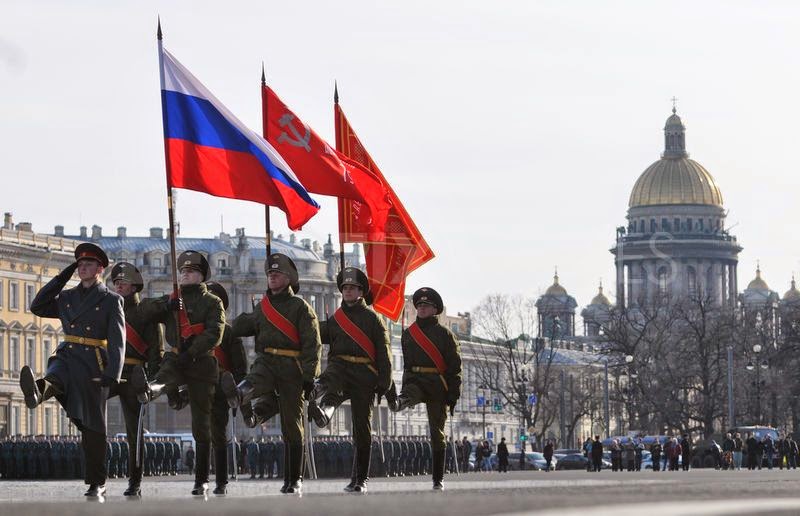
Next week is Victory Day on 9th May.  This happens every year to commemorate victory over Nazi Germany in The Great Patriotic War, as the Russians call the Soviet part of the Second World War.  Parades are held in cities; the largest being in Moscow.  However, my host city, Saint Petersburg, will hold theirs on Palace Square, outside the Hermitage Museum.  This I intend to see and take some video footage, as well as some photos which I'll post on this blog.


So, the purpose of VD is to remember those who served in the Red Army, in defence of the Motherland and the final westward assault on the Third Reich ending in May 1945.  As time passes, fewer and fewer veterans of that conflict are able to attend.  However, they are not forgotten.  The parade will consist of members of the modern armed forces of The Russian Federation, including the city's cadets.

Palace Square with St Isaac's Cathedral in the background
 
 
Female soldiers and cadets (above) Russian veterans (below)


Russian Forces Today

The modern Russian army, air force and navy may not be on the grand scale of the old Soviet armed forces, but it is still a large size with a huge amount of firepower.  Eyes are now looking at the Russian military as the crisis in eastern Ukraine continues.  Of course the question is: will they be used to intervene in Ukraine in the near future?  Whatever the answer, the facts are quite clear about the Russian military:  they are well-equipped, have large numbers and have some of the best-trained and experienced special forces in the world.  A formidable foe for any army.
 
Russian Armed Forces (HD)
 
It is not uncommon to see young conscripts and cadets walking around the city in their uniforms.  I see them nearly everyday on the metro.  Some of the cadets attend a military school  I say school, because they are just schoolboys in military uniform.  When a young man reaches eighteen, if he is deemed physically and mentally fit, he is eligible to do a period of national service.  This can be delayed if the man enters university.  While thousands of young men avoid service each year (resulting in arrests), tens of thousands are fed into the ranks of the Russian military. 


Source:   http://www.ft.com
 
As you can see by the numbers above, it's a military that dwarfs my own country's numbers. 
 

The Army: Сухопутные войска Российской Федерации


Army uniform insignia with tricolour (above) VDV paratroopers (below)

 VDV: Воздушно-десантные войска - Air-Land-Forces
 

Special Forces - Speznaz

 
The first time I had heard of Speznaz (special forces) was a film from the 80s starring Dolph Lundgren.  It was called 'Red Scorpion' They were portrayed as the Soviet elite.  Today Russia's Speznaz can be found in the army and the Ministry of Interior/FSB.  GRU Speznaz are attached to the intelligence wing of the army - ГРУ ГШ) or Glavnoye Razvedyvatel'noye Upravleniye Generalnovo Shtaba (Главное Разведывательное Управление Генерального Штаба) meaning Main Intelligence Directorate of the General Staff.  During the last decade or so, Speznaz have been used to fight against separatists in the Caucuses  - most notably in Chechnya and Dagestan.


 GRU Speznaz:  Russia's elite


The Airforce:  Военно-воздушные cилы России


MiGs and Sukhoi fast jets make up the fighter wings of the Russian Air Force.  The picture above is the new MiG 35 multirole fighter which was derived from the very capable and agile MiG 29 Fulcrum.  It first flew in 2007.
 
The iconic Hind attack helicopter has been revamped into the new Mi-35:
 
 
The Kamov Ka-50 below: 


The Navy:  Военно-морской Флот Российской Федерации (ВМФ России)


And finally... Russian Navy hovercraft lands on a crowded beach:


Tuesday, 15 April 2014

The Ukraine and Crimea


It has been on my mind for several months now.  When the Russians seized Crimea I thought this at the very least could trigger a new Cold War between Russia and NATO countries.  At the very worst it could trigger a Third World War - and we know how that would end? 

I'm not going to repeat what has already been reported about the on-going tension between my host country of Russia and it's neighbour Ukraine (and the west).  But, it has got me worried.  Now, at the best of times I am a natural worrier.  If there was nothing to worry about, I would still worry  - about the fact there was nothing to worry about.  So, when there was talk about the crises escalating into a possible military conflict in the region, I thought...oh shit, we might be at war very soon!  I thought and worried some more  Okay, if the proverbial hits the fan and I have to leave Russia, where am I going to go?  The airports may be closed or overcrowded with EU nationals clambering to escape the Federation.  Well, I am in Saint Petersburg, and that means there's always a land route to Finland.  I pictured myself getting on a coach to Helsinki, or if that was not viable, trudging across the border.


This would be a pretty cool way to cross the border  All I need now is a sleigh, some huskies and some snow!


Then there was a lull.  As you already know, Russia held a referendum in the Crimean peninsular, amidst an outcry of foul-play from the west and the new Ukrainian government.  In a short space of time Crimea was incorporated into The Russian Federation.  And now tensions are building up again.  Armed gunmen have seized police stations in the Donetsk region of Ukraine.  The Russian government have said that they would send in their special forces if the Ukrainian military try to act against them.  Claim and counter-claim from both sides.  This is politics and it is always the little man (the general public who just want to get on with their lives) who suffers.  The question is now:  will this lead to war?


I hope not.  A war between Russia and Ukraine would lead to a wider conflict and may be even nuclear war.  While the situation worsens and politicians on both sides fan the flames, they have forgotten that they are putting all of our lives in jeopardy.  I sincerely wish for a peaceful outcome to this crisis.  Both sides have something to offer, but please, for the sake of ordinary Russians, Ukrainians and the rest of the world, the politicians must de-escalate and stop playing with fire.  Nor, do I like the way that nationalists have taken this as an opportunity to voice their xenophobia - be they Russian, Ukrainian, or whoever.  As a Briton living in Russia, I think it is sad that neighbours, who have so much in common, are now at logger-heads.  Who's to blame?  Politicians with their own agenda and a minority of bigots in both countries.  This reminds me of the conflict in Northern Ireland with idiots on both sides of the divide stirring up hatred.  It has to stop.  I've heard and read some unsavoury comments - anti-Russian and anti-Ukrainian, in the last few weeks.  Most people, as I've already said, want to live in peace.  For those who want a fight, you are risking a lot - and for what?
 
As John Lennon once sang:  
 
In the meantime, I'm going to carry on as normal, teaching my classes and enjoying the Russian spring.  I still want to be here tomorrow, and the day after that, and not on some evacuation flight, or thousands of metres into the stratosphere!